
It is no secret that a positive and healthy workforce makes for a positive and healthy working environment – which, in turn, promotes employee engagement and productivity. And with World Day for Safety and Health at Work observed on Friday 28 April, what better time to take a good, hard look at some basic safety practices and attitudes?
Haslop & Mason managing member Kevin Dersley outlines some essentials of safety in the workplace:
‘We all know that real safety excellence is achieved through a combination of factors – leadership priorities, a finely tuned strategy, staff engagement and of, course, a huge emphasis on safety culture.
‘A safety culture does not happen overnight. It involves far more than rules of what to do when. Great training forms the basis, but appropriate levels of trust, responsibility, and decision-making powers, vested in workers, also play a role.
‘Emergencies cannot be predicted – no two events are ever the same. Therefore, staff working with machinery have to be trained for and entrusted with a certain level of decision-making capability. The unexpected will happen. You need your staff engaged, informed and fully invested in the safety process – the thinking behind the rules.’
That said, there are some basics that everyone needs to be aware of – both in terms of behaviour and the safety features of modern machinery. Electrical components and processes, too, can be made inherently safer through certain modifications.
Let’s take a look at some of the safety features you can expect to find on the factory floor of forward-thinking companies that prioritise the health and safety of their workers.
Electrical safety: Electrical hazards are everywhere. Workers must be made aware that safety protocols are not optional – they are to be practised everywhere, every time, even when no-one is looking. Electrical safety features include arc flash containment enclosures, intelligent components, and personal safety training. Motor control centres will allow operators to disconnect the power from an individual plug-in unit without opening the enclosure door.
 Machine safety: Machine operators must be protected from moving parts, by physical guards preventing them from getting too close, or by sensors that will switch off a machine if operators move into a danger zone. Sensors may include light curtains, pressure-sensitive safety mats, or laser scanners, such as those from the Rockwell Automation Guardmaster range.
Process safety: This is a major industry concern. In moving up the safety maturity ladder, companies should strive to foster a no-blame culture that incentivises workers to report every incident, because even the smallest incident can have enormous repercussions. If small malfunctions are not reported, and a tragedy occurs, those little unreported incidents will come to light eventually.
Encourage transparency and back it up by not blaming. Instead seek to find ways, together with workers, to ensure that the conditions that give rise to safety breaches simply cannot occur. On a technical level, ensure that safety instrumented functions (SIF) are identified, and their level of performance and safety integrity level (SIL) are maintained.
Demanding the highest level of safety helps to protect personnel, the environment, and assets! In the end, a major focus on safety can only benefit productivity.
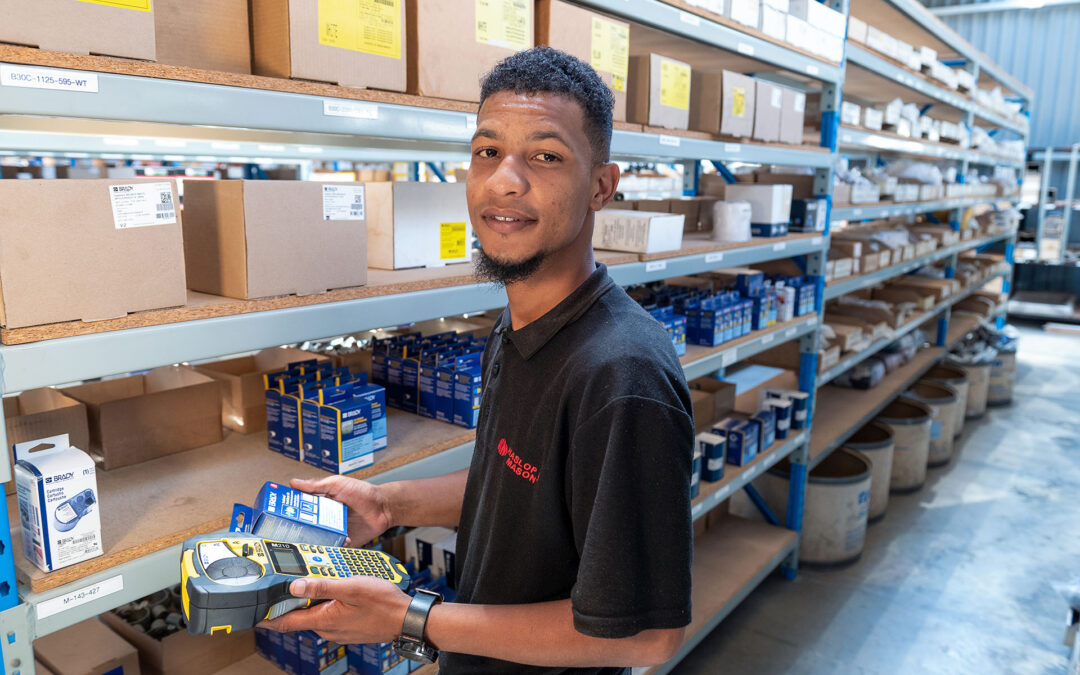
 Tools and labels safety: Our supply partner, Brady, offers a number of safety-first features on its products:
- Lock Out Tag Out (LOTO). The LOTO feature enables a worker to switch off the electrical supply to a machine or to part of a plant to allow for maintenance.
- Safety and facility identification. Brady supplies labels for hazardous materials, high-risk areas and supply cables, along with floor markings for access routes.
- Spill control. Spilled fuels can ignite, and oil on the floor can break legs! Brady supplies a wide range of products for both preventive and reactive spill control.
For Haslop & Mason, productivity and safety are corresponding measures of business success. Best-in-class companies achieve higher overall equipment effectiveness, less unscheduled downtime and fewer injuries than those that are still low in safety maturity.
We’re striving for excellence in all things, including worker health and safety. Let’s elevate the entire manufacturing sector by ensuring that leaders care about their workers, safety compliance becomes second nature, and staff are incentivised to report incidents.
Well-designed technology plays a central role in keeping workers safe. But real gains are made when the entire company adopts a safety culture, and everyone from the boardroom to the factory floor looks out for one another. Let’s stay safe this World Safety Day, and every day!